



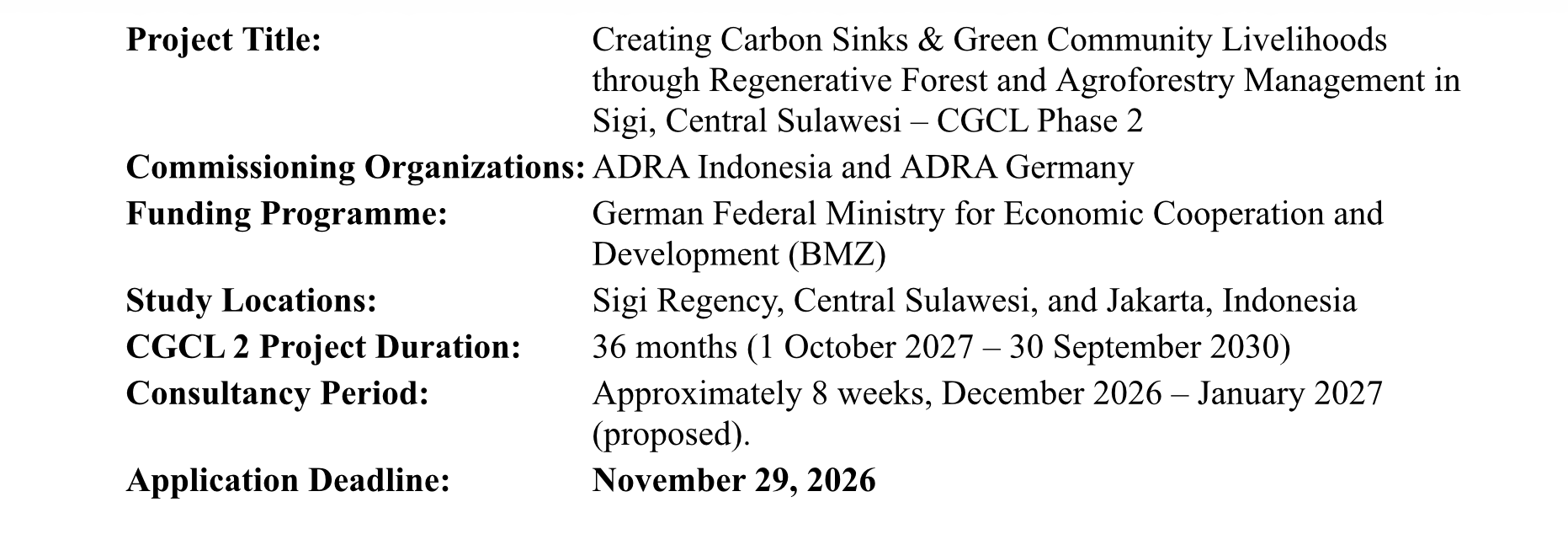
ADRA Indonesia is seeking an independent consultant to conduct feasibility study to the propose climate mitigation and green livelihood project, as summarize below:
1. Background and Project Context
ADRA Indonesia, with funding support from ADRA Germany and BMZ, has been implementing the Creating Carbon Sinks and Green Community Livelihoods (CGCL) project since September 2024 in 12 villages of Marawola Barat Subdistrict, Sigi Regency, Central Sulawesi. The project promotes nature-based solutions, sustainable forest management, community-based agroforestry, through strengthening the capacities of indigenous communities and local institutions introduce carbon credits and improving livelihoods.
Central Sulawesi has considerable potential for community-led climate mitigation through its social forestry and customary forest landscapes. However, persistent challenges, such as unclear land and forest tenure, limited institutional capacity, inadequate technical and financial resources, and low access to market, constrain communities’ ability to manage natural resources sustainably and benefit from climate finance.
Building upon lessons learned from Phase 1, ADRA Indonesia and ADRA Germany are developing CGCL Phase 2 for implementation during October 2027–September 2030. The proposed project aims to consolidate and expand the achievements of the first phase by strengthening customary institutions, improving forest and land-use governance, promoting sustainable agroforestry-based livelihoods, and supporting customary law institutions and villages to access climate finance through restoration and conservation for carbon sink.
The preliminary project concept identifies approximately 26 social forestry permits covering 26,000 hectares as a potential intervention landscape, with an indicative target of 2,500 indigenous individuals across existing and new project areas. These figures remain subject to independent verification during the feasibility study. The project overall target is to contribute to climate change mitigation and increase livelihoods of indigenous and forest-dependent communities in Sigi, Central Sulawesi, through strengthened customary forest governance, regenerative forest and agroforestry management and access to climate finance.
CGCL Phase 2 is structured around four proposed objectives:
1. Strengthening forest and land-use governance: Support customary communities in strengthening and formalizing Customary Law Institutions, clarifying customary territories, and advancing legal recognition of customary forest management rights.
2. Improving sustainable livelihoods: Strengthen post-harvest management, market access, value addition, and green value chains for agroforestry commodities in existing and newly targeted communities.
3. Operationalizing community-based climate finance: Assess and strengthen the implementation readiness of existing carbon project documentation, support appropriate carbon registration pathways, and evaluate the feasibility of developing at least five Climate Mitigation Action Documents (DRAM) in additional target areas, including investments in community-based nurseries.
4. Developing an evidence-based scalable model: Generate practical evidence, strengthen partnerships with academic institutions and relevant government ministries, and develop replicable approaches to community-based forest management and climate finance.
An independent feasibility study is required to examine the relevance, feasibility, risks, institutional arrangements, economic viability, and sustainability of the proposed interventions and to provide evidence-based recommendations for the final project design.
2. Purpose of the Assignment
The purpose of this assignment is to conduct an independent feasibility study to determine whether the proposed project is technically, institutionally, legally, environmentally, socially, and economically feasible within the proposed three-year implementation period.
The study shall critically assess the assumptions underlying the project concept, identify potential barriers and opportunities, and recommend adjustments to improve its effectiveness, sustainability, inclusiveness, and value for money. The consultant is expected to provide an independent assessment, recommendations based on the findings and evidence collected from community, government and CSOs consultations, including analysis at national and local government policies analysis.
3. Specific Objectives of the Feasibility Study
The feasibility study will independently determine whether, where and under what conditions the proposed project can deliver equitable livelihood improvements and sustainable forest management benefits within the proposed resources and 36 months implementation period. It will also assess the feasibility and added value of carbon finance as a potential supporting mechanism, compare realistic alternatives and recommend whether the project and its specific components should proceed, be redesigned, deferred or discontinued.
The consultancy shall:
1. Independently verify the problem analysis, community preferences, Phase 1 evidence and lessons, and proposed geographic and beneficiary scope.
2. Establish the legal, tenure, institutional, technical and safeguard prerequisites for the proposed interventions.
3. Evaluate the technical and regulatory feasibility of forest conservation, restoration, agroforestry, and associated carbon mitigation activities.
4. Test customary rights recognition pathways, forest tenure and social forestry status, proponent eligibility and governance arrangements.
5. Assess climate mitigation plausibility and carbon finance readiness (not guaranteed credit issuance), including legal pathways, costs, uncertainties, long-term obligations and likely net community benefits.
6. Assess viable agroforestry commodities, processing investments, market access, net household benefits and distributional impacts.
7. Evaluate the organizational, technical, financial, and implementation capacities of the proposed project partners and community institutions.
8. Identify social, environmental, governance, financial, and climate-related risks, including gender equality, disability inclusion, and safeguards.
9. Test the proposed theory of change, targets, implementation sequence, budget assumptions, and sustainability strategy.
10. Provide recommendations for improving the project design, theory of change, results framework, institutional arrangements, and implementation strategy.
4. OECD-DAC assessment questions
11. The study will evaluate the proposed project against all six OECD-DAC criteria using forward-looking questions and proportionate evidence.
4.1 Relevance: Are we proposing the right interventions?
1. Are the focus, priorities and objectives (approach) of the planned project clearly defined and aligned with the beneficiaries? To what extent do the intervention objectives and design adequately take into account the specific needs of the beneficiaries and any structural obstacles in the project region, partner/institution, or policy programs?
2. Do forest governance, livelihood and carbon finance components address independently verified root causes rather than assumed needs?
3. Land tenure status of customary and village forests planned, with estimated target5,250 people are appropriate, feasible and verifiable? What selection criteria and disaggregation are needed?
4.2 Coherence: How well does the proposal fit?
1. To what extent do synergies and connections exist between the planned project and other interventions by the same stakeholder (organisation) and other stakeholders?
2. What are the current legal requirements and potential conflicts governing customary community recognition, customary forests, social forestry, carbon proponents, registration, claims and benefit-sharing?
3. Which existing forest protection, jurisdictional carbon, results-based payment or donor initiatives overlap with the proposed landscape? Is duplication or double counting possible?
4. What roles and coordination arrangements are suitable for district/provincial government, relevant ministries, community institutions, universities, CSOs, carbon service providers and private buyers?
4.3 Effectiveness: Can the four objectives realistically be reached?
1. Does the Theory of Change credibly link planned activities to measurable outcomes? What assumptions, prerequisites and external decisions determine success?
2. What is Phase 1’s verified performance and what unresolved technical, governance or capacity gaps could constrain expansion?
3. Can customary institutions and communities realistically achieve relevant legal milestones within 36 months, and which steps depend on authorities outside project control?
4. Are five DRAMs justified and achievable? Are grouped/project-wide approaches more practical? What evidence would demonstrate readiness at each stage?
5. Is the chosen methodological approach suitable and sufficient for achieving the project objective? Are alternatives required?
4.4 Efficiency: Can results be achieved at reasonable cost and on time?
1. To what extent can the planned measures be implemented with the envisaged funds in the proposed time period ?
2. Are groups of CLIs and LPHDs are feasible, and what are the comparative costs of separate DRAMs versus grouped options, including baseline, validation, MRV, verification, safeguards and administration?
4.5 Impact: What larger positive and negative changes are plausible?
1. What climate mitigation or carbon stock outcomes could plausibly result from conservation, restoration and agroforestry? Explicitly distinguish avoided losses from additional removals.
2. What plausible livelihood, forest-governance, biodiversity and social equity effects could result? What adverse effects or trade-offs could undermine them?
4.6 Sustainability: Will benefits last beyond BMZ funding?
1. who will maintain forest management, nurseries, monitoring and grievance systems after project closure, and with what authority and recurrent budget?
2. Can core benefits continue without donor subsidies or uncertain carbon credit revenue?
3. Are carbon permanence, reversal buffers, monitoring commitments and benefits-sharing governance financially and institutionally sustainable?
5. Mandatory cross-cutting feasibility tests
– Legal and Land Rights: Verify social forestry permits, customary land rights, and forest boundaries. Identify land conflicts and determine who has the legal right to manage forests and participate in carbon projects.
– Carbon and Climate: Assess the potential for reducing emissions and increasing carbon storage. Review carbon project requirements, risks, monitoring needs, and potential financial benefits.
– Agroforestry and Livelihoods: Identify 2–3 promising agricultural or agroforestry products. Assess market opportunities, post-harvest improvements, investment costs, and potential income benefits for households.
– Gender, Disability, and Social Inclusion (GEDSI): Assess how women, persons with disabilities, indigenous peoples, and vulnerable groups can participate and benefit fairly. Review community rights, safeguards, and complaint mechanisms.
– Institutional and Financial Capacity: Assess the capacity of local institutions and project partners, including staffing, responsibilities, project costs, implementation schedule, and key risks.
6. Methodology
The consultant shall propose a justified mixed-method design proportionate to the study’s objectives, geographic scope and timeframe. The study shall generate sufficient evidence to assess the proposed project against all six OECD-DAC criteria. The methodology shall include desk review; household survey, key informant interviews; participatory and appropriately separated FGDs; representative site verification; market and financial assessment, site verification andgeospatial checks and stakeholder validation.
Desk review: review the proposed project concept, result framework and indicative budget, relevant studies and policies, available tenure and permit records, and existing carbon project documentation.
Household survey: collect quantitative data on livelihood conditions, forest and land-use practices, access to resources, participation barriers and anticipated benefits and cost relevant to project design. The survey shall complement qualitative and documentary evidence rather than attempt to establish a comprehensive baseline.
Key informant Interview: consult with relevant community institutions, implementing partners, government authorities, tenure and carbon specialists, CSOs, technical service providers and market actors. Examine institutional capacity, regulatory pathways, implementation dependencies and alternative approaches.
Participatory focus group discussion: explore community priorities, rights, incentives, potential trade-offs and benefit sharing expectations. Conduct separate discussions where necessary to enable women, youth, PWDs, and marginalized groups to participate safely and meaningfully.
Site verification and geospatial checks: Verify selected forest, restoration, agroforestry, nursery and processing locations through structured observations, available spatial data and supporting documents. Examine boundaries, overlapping claims, ecological suitability, infrastructure, accessibility and operational constraints. Clearly identify matters that cannot be verified within the assignment.
Market and financial assessment: Consult producers, buyers and relevant service providers to assess demand, quality requirements, market access, investment and operating costs, and potential net household benefits. Compare feasible intervention and carbon-finance options using transparent assumptions and sensitivity analysis, including scenarios with no carbon revenue, delayed revenue and higher costs.
Stakeholder validation: Present preliminary findings to relevant stakeholders to check factual accuracy, test interpretations and discuss implications for project design. Document unresolved disagreements and preserve the consultant’s independent judgement.
Sampling strategy
The consultant shall submit justified sampling plans for quantitative and qualitative data collection and site verification. Select sites to reflect Phase 1/new areas, differing tenure status, remoteness, ecological condition and livelihood potential. Specify sampling rationale and limitations.
7. Deliverables
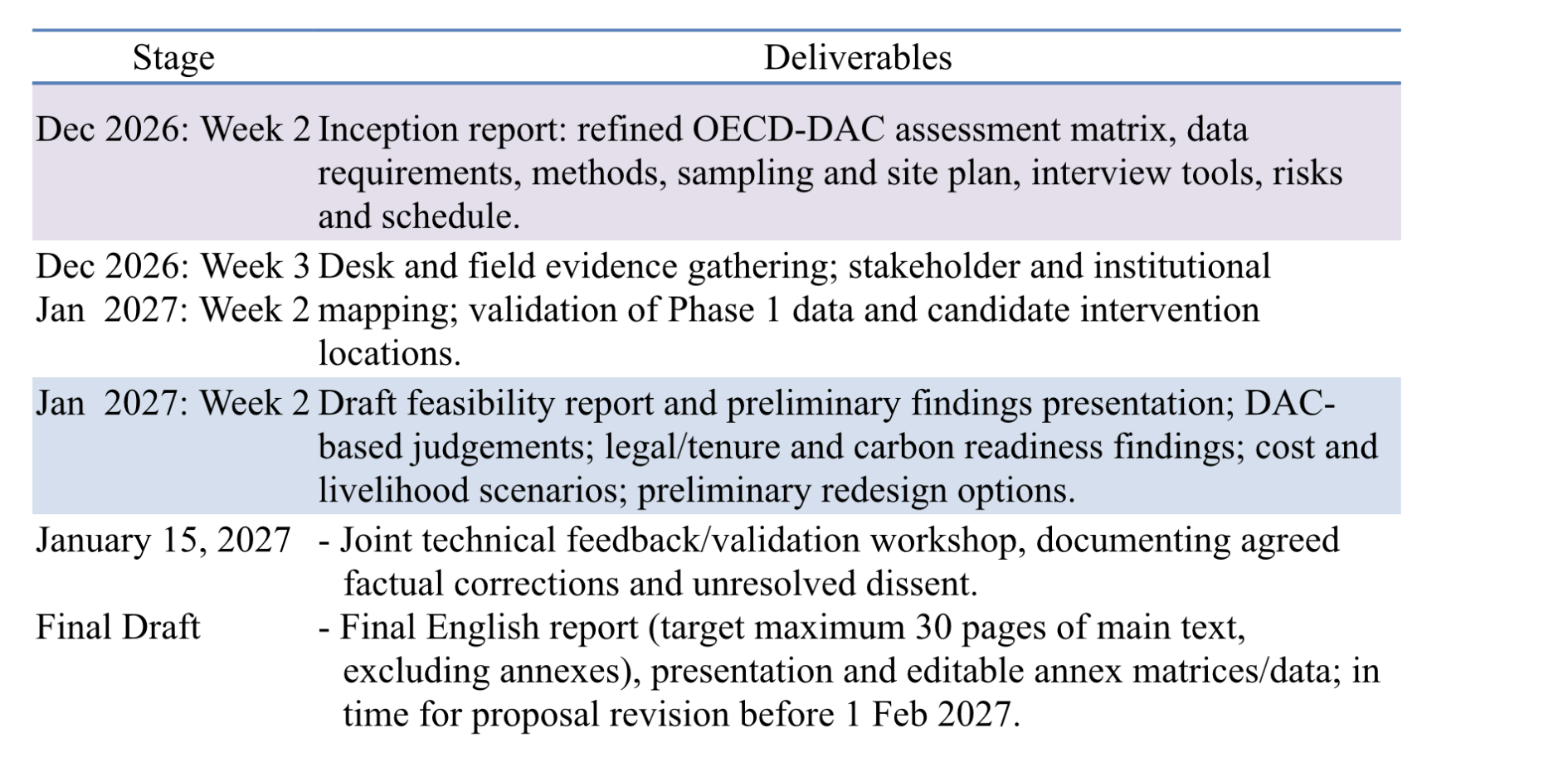
The consultant will be responsible for delivering following outputs within the agreed timeframe.
7.1 Inception report
The consultant team/firm shall submit a comprehensive inception report (maximum 10 pages for the main text, without the front page, table of contents and annexes) in Microsoft Word format, using Arial 11-point font, 1.15-line spacing, and standard margins. The inception report must include:
• Comprehensive methodology including sampling approach (specifying proposed numbers of sites, households, interviews and discussions, along with their distribution and selection procedures), data collection methods, and analytical framework with specific attention to gender-responsive approaches
• Complete data collection tools (questionnaires, interview guides, FGD protocols) with translation into local language
• Assessment matrix linking each priority feasibility and OECD-DAC question
• Detailed work plan with a timeline
• Team composition with clear roles and responsibilities
• Quality assurance and ethical protocols including data protection measures
Data collection shall begin only after approval of the inception report and tools.
7.2 Feasibility study report
The feasibility study report, both draft and final, should be max. 30 pages for the main text, including the executive summary but excluding the front page, table of contents and annexes. The report must contain an executive summary of a maximum of five pages and mandatory annexes.
The consultant will prepare a draft feasibility study report, followed by a debrief meeting with the consortium partners, where the consultant team/firm will make a presentation on the draft report. The final draft report shall then be submitted, incorporating feedback and input from the debriefing meeting. The report should be prepared following the structure outlined below:
1. Front page (including Title, Name of consultant team/firm and Date)
1.1 Executive summary
• A brief overview of the project
• Key objectives of the study and intended users/audience
• key findings and recommendations
2. Table of contents
3. List of Acronyms/Abbreviations
4. Introduction
• Background and context
• Purpose and use of the study
• Objectives of the study
• Scope of the study
5. Methodology
• Survey design including rationale for choosing the method
• Sampling strategy
• Data collection tools
• Data analysis
6. Limitations
7. Initial situation and problem analysis, on macro-meso-and micro-levels
8. Local project partner in partner country
9. Beneficiaries and other stakeholders (on a micro-, meso- and macro-level
10. Evaluation of the planned project based on OECD-DAC criteria
11. Conclusion and recommendations
12. Annexes
• Terms of Reference and Inception Report, including the approved methodology and work plan.
• OECD-DAC Assessment Matrix, linking evaluation criteria, key questions, evidence sources, and findings.
• Site and Beneficiary Selection Matrix, including selection criteria, sampling methods, and target group characteristics.
• Stakeholder and Institutional Capacity Map, including relevant government agencies, customary institutions, implementing partners, and community organizations.
• Legal, Land Tenure, and Carbon Finance Assessment, including forest management rights, regulatory requirements, and carbon registration pathways.
• Alternative Interventions and Value-for-Money Analysis, including cost comparisons and financial scenarios.
• Risk and Safeguards Register, covering environmental, social, institutional, financial, and implementation risks.
• Recommended Theory of Change and Results Framework, including proposed outcomes, outputs, indicators, and key assumptions.
• Data Collection Tools and Supporting Data, including interview guides, questionnaires, anonymized datasets, and relevant analyses.
• Stakeholder Consultations and References, including stakeholders consulted, consultation summaries, and key reference documents.
• Supporting Documentation, including relevant maps, tables, charts, photographs with consent, and other essential materials
It is important to note that the final report requires the approval of the contracting party. In case of dissent, there should be documentation of the matter.
7.3 Presentation of Findings
The consultant team/firm will prepare a PowerPoint presentation summarizing key findings and recommendations and conduct at least one presentation session for the consortium partners and broader stakeholders including relevant government entities. The consultant team/firm will also develop appropriate visual aids (infographics, charts) to effectively communicate baseline findings.
All deliverables must be submitted in English, with professional quality writing, proper referencing, and adherence to ADRA’s guidelines. Electronic copies of all materials, including raw and clean datasets, must be provided in appropriate formats.
8. Required Products and Reporting.
9. Consultant Qualifications
An independent multidisciplinary team is preferred: Team leader experienced in BMZ-style feasibility studies/OECD-DAC assessment; Indonesian customary tenure/social forestry expert; forest carbon/regulatory/MRV expert; agroforestry value-chain and financial analyst; and strong GEDSI/safeguarding competence.
Desirable qualifications:
1. Previous experience with BMZ-funded development projects and Engagement Global/bengorequirements.
2. Experience preparing or reviewing carbon project documents, including DRAM/PDD and relevant MRV requirements. Knowledge of Indonesian customary forest recognition and carbon market regulations.
3. Field experience in Central Sulawesi or comparable forest landscapes.
4. Capacity to undertake geospatial assessment and preliminary financial modelling.
10. Management, ethics, applications and procurement
ADRA Indonesia shall coordinate local access and logistics and ADRA Germany shall contribute donor/compliance review. Proposals should include methodology and DAC assessment matrix, team CVs, work plan, itemized financial budget including field costs and taxes, relevant samples and references, and conflicts-of-interest declaration.
All consultations shall apply informed consent, confidentiality, safeguarding, risk-sensitive handling of customary boundaries, and transparent protection of community rights. Sensitive land, boundary and carbon-related information shall be handled in ways that minimize conflict and exposure.
Community participation does not constitute FPIC for any future investment unless separately conducted under applicable standards.
11. General data protection regulation
The feasibility study will implement comprehensive data protection measures aligned with the best international practices and legal requirements. All personal data collected during the assessment will be handled in strict compliance with the European Union General Data Protection Regulation (EU GDPR) and relevant Indonesian data protection frameworks. The study will establish clear data governance protocols, including secure data collection mechanisms, encrypted storage systems, and controlled access privileges limiting data handling to authorized personnel who have signed confidentiality agreements. Before data collection, participants will receive detailed information about data usage, storage periods, and their rights regarding personal information following GDPR principles, with consent forms explicitly outlining data processing purposes and retention timelines. The study will implement data minimization strategies, collecting only information directly relevant to the study’sobjectives.
All documents and data obtained from documents, interviews, and meetings are confidential and are to be used solely for the purpose of the survey. The deliverables, as well as all materials related to the survey (produced by the consultant(s) or the organization itself), are confidential and remain the property of the contracting party at all times.
Please submit your application to : recruitment@adraindonesia.org
with email subject “Independent Consultant”